


Jul 13, 2026
Jul 13, 2026
Giving Better: KPMG's Rachel Decelis Brings the Data to Malta's Sustainability Conversation
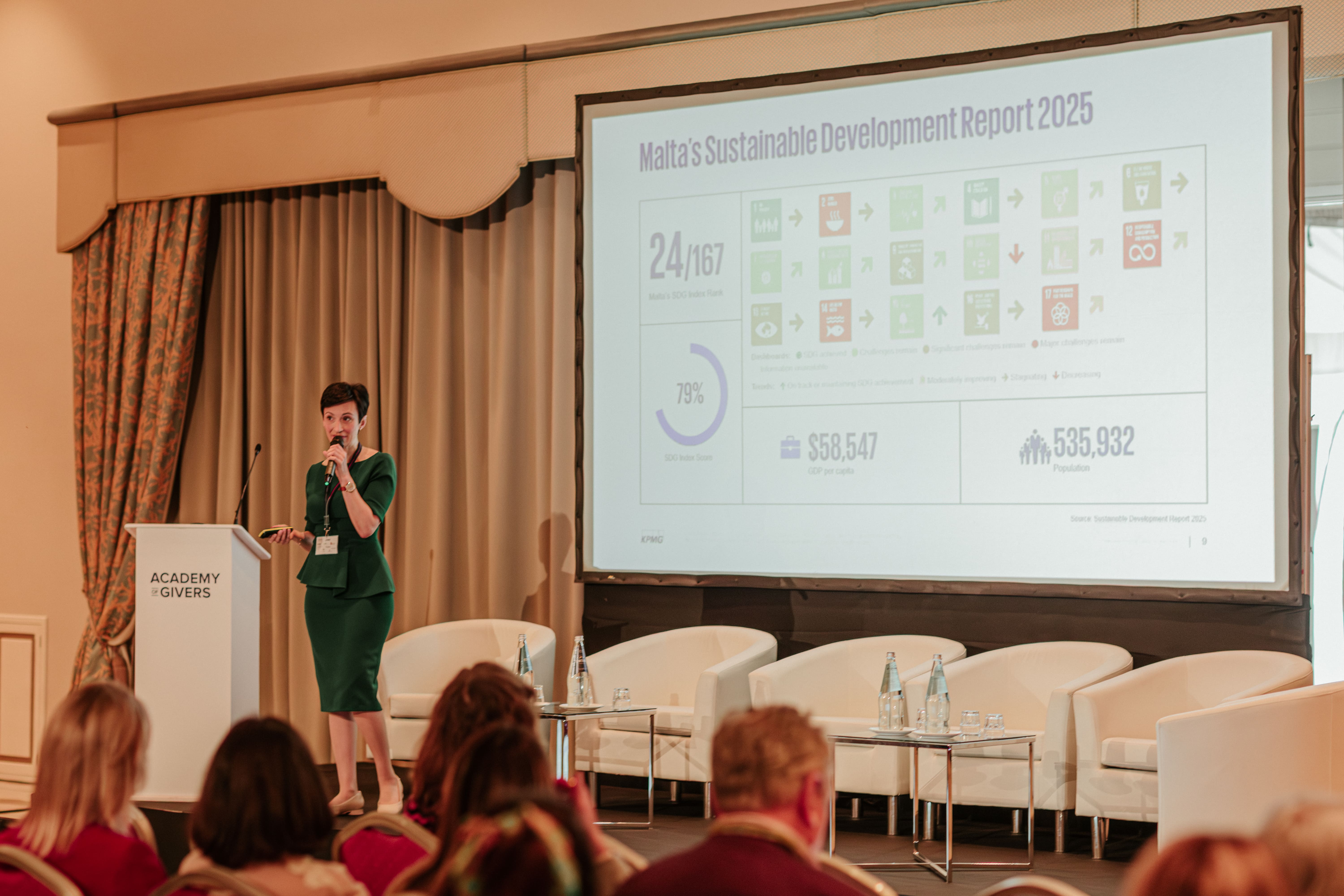
Rachel Decelis, former Associate Director and ESG Lead at KPMG in Malta, took the floor of our 2026 Conference with a keynote titled "Malta's most pressing sustainability issues: Key data."
When the Academy of Givers gathered business leaders, NGOs, policymakers and sustainability professionals at The Xara Lodge for the fifth edition of its Annual Conference and Impact Fair earlier this year, the theme set the tone before a single speaker took the stage: Giving Better. Not giving more, but giving with clarity, intention and measurable impact. Academy President Mark Weingard framed it early on: in a time of growing challenge but also growing knowledge and capability, the question facing Malta's business and philanthropic community is no longer whether to give back, but how to do it well.
It was in that spirit that Rachel Decelis, former Associate Director and ESG Lead at KPMG in Malta, took the floor with a keynote titled "Malta's most pressing sustainability issues: Key data." Rather than another set of aspirational talking points, Decelis grounded the conversation in numbers, pulling together public opinion surveys, global risk indices, national statistics and recent local events into a single, sobering picture of where Malta stands.
Decelis opened not with abstractions but with recent headlines, mapping each event ontothe classic ESG lens (Environmental, Social and Governance) to show how asingle incident ripples across all three dimensions at once.
- Storm Harry exposed the increasing frequency of extreme weather (E), laid bare the vulnerability of Malta's homeless population during the storm (S), and left a controversy in its wake over the compensation scheme that followed (G).
- A beach closure due to contamination pointed to ecosystem degradation (E), a loss of public trust in the agencies responsible (S), and a longer-standing lack of investment behind the failure (G).
- Health and safety incidents in construction raised fears for community safety and confidence in infrastructure (S), prompting a review of Malta's local plans (G).
- The housing affordability crisis is pushing young people into larger, longer loans just to get on the property ladder (S), with implications for fair housing policy, transparency and regulatory trust (G).
- A summer heat wave brought biodiversity loss, drought, wildfire risk and energy system stress (E), alongside real health risks and strain on the healthcare system (S).
The message running underneath all five is clear: these are not isolated news stories; they are recurring symptoms of the same underlying pressures. Climate volatility, resource strain and gaps in institutional trust are already showing up in ordinary Maltese life, not just in future projections.
Decelis then turned to the Standard Eurobarometer 104 survey (October–November 2025), which captures how Maltese and EU citizens feel about their lives and their countries.
The headline number is a good-news one: 92% of people in Malta report being satisfied with life, notably higher than the EU 27 average of 86%. But satisfaction at the personal level doesn't mean complacency about the bigger picture. At the national level, the cost of living dominates Maltese concern (40%, up 5 points), followed by immigration (30%, up 10 points) and, climbing fastest of all, the environment and climate-related risks, which jumped 8 points to 26%, three times the EU 27 average of 8%. Housing and government debt also register well above the EU average.
Interestingly, the picture shifts at the personal level: cost of living concern spikes even higher (61%, up 16 points), while climate concern, though still elevated relative to the EU (26% vs 9%), drops behind it in personal ranking. The takeaway Decelis drew out: Maltese residents see climate and environmental risk as a serious national problem, even if it hasn't yet displaced the cost of living as their most immediate personal worry.
To place Malta's concerns in context, Decelis referenced the World Economic Forum's Global Risk Perception Survey 2025-2026. Over a two-year horizon, respondents worldwide rank geoeconomic confrontation, misinformation and societal polarisation as the top risks. But stretch the horizon to ten years, and the picture reorders dramatically: extreme weather events, biodiversity loss and ecosystem collapse, and critical changes to Earth systems take the top three spots. It's a reminder that short-term political and economic anxieties can crowd out longer-term environmental risk in public attention, even though the data says the latter is where the more severe, harder-to-reverse damage accumulates.
The keynote's data core came from Malta's Sustainable Development Report 2025, which ranks the country 24th out of 167 nations on the SDG Index, with a score of 79%. Decelis walked through where Malta is genuinely improving and where the picture is far less comfortabl
- Climate action (SDG 13): Malta's mean annual air temperature has risen steadily since the 1950s, with the highest annual average recorded in 2016 at 20.1°C, and sea temperature up nearly 2°C between the 1978–2020 reference period. Meanwhile 75% of years between 2001 and 2020 saw rainfall fall below the historical climate norm. A compounding drought signal alongside the heat.
- Transport (SDG 3, air quality): The stock of licensed vehicles has climbed relentlessly, from roughly 272,000 in 2005 to nearly 446,000 in 2025. A trend with direct consequences for the air-quality and premature-mortality data shown alongside it, even as Malta has still made progress against the EU's PM2.5 reduction target.
- Public health (SDG 2): Perhaps the starkest single figure of the session: close to 70% of the Maltese population is overweight or obese, among the highest rates in Europe, a public health burden with knock-on effects for healthcare costs and workforce wellbeing.
- Water and marine health (SDG 6 and 14): National water consumption has been on a rising trend since 2019, while E. coli levels in coastal bathing zones have shown volatile, and in some zones worsening, trends between 2010 and 2015, data that connects directly back to the beach-closure incident discussed earlier in the keynote.
- Inequality (SDG 10): This was flagged as one of the more concerning trend lines in the whole report. Malta's Gini index — a standard measure of income inequality — held broadly steady between 28 and 30 for over a decade, then rose sharply after 2018 to above 34 by 2022. The proportion of the population living below 50% of median income shows a similar late shock, dropping to a low of around 7.8% in 2021 before spiking back up toward 11% by 2022. Both point to a fast-widening gap that the Sustainable Development Report itself flags as "decreasing" performance, one of the few indicators moving in the wrong direction.
Housing, climate, health, inequality and public trust were treated throughout as an interconnected system because understanding the data properly, in its full ESG complexity, is a precondition for businesses and NGOs to direct resources where they will actually make a difference, rather than where the most visible headline happens to be.
Missing those connections means risking exactly what this year's conference theme was warning against: giving that feels good but doesn't move the needle. Mrs Decelis's keynote offered a shared, evidence-based starting point to the “Giving Better” CTA of the whole conference: it asked businesses and NGOs to look past the most visible headline and toward the underlying, interconnected data, so that time, money and effort land where they will actually shift outcomes for the people and ecosystems most exposed.
Privacy Notice

.png)
